WICV 2025 Releases Phased Achievements of the “Vehicle-Road-Cloud Integration” Pilot Program of Intelligent Connected Vehicle
Date:2025-10-19 20:44
Typeface【 Default large Extra large 】
On October 16, the 2025 World Intelligent Connected Vehicles Conference (WICV 2025), jointly hosted by the Ministry of Industry and Information Technology (MIIT), the Ministry of Transport (MOT), and the People’s Government of Beijing Municipality, opened in Beijing E-Town. During the Opening Ceremony, Li Keqiang, Academician of Chinese Academy of Engineering, Professor at Tsinghua University, and Chief Scientist of the National Innovation Center of Intelligent and Connected Vehicles (CICV), released the phased achievements of the “vehicle-road-cloud integration” pilot program of intelligent connected vehicle (ICV) on behalf of the Conference.
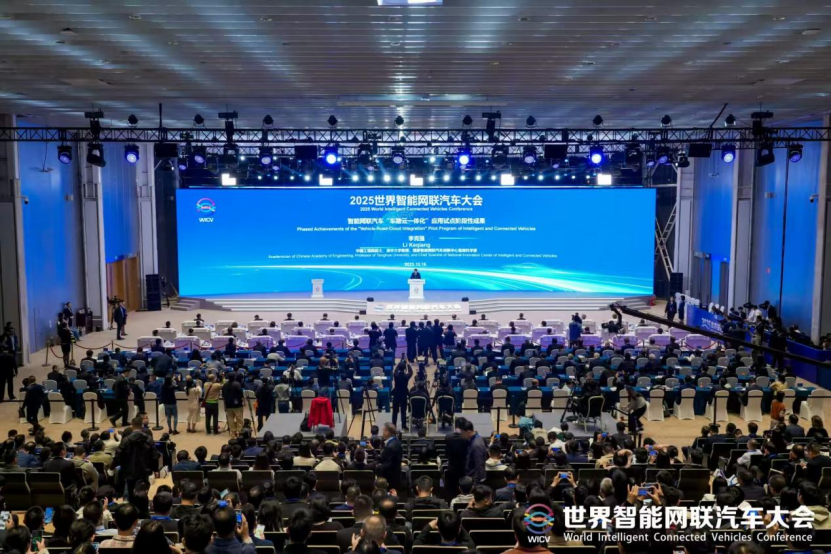
In 2024, the MIIT, the Ministry of Public Security, the Ministry of Natural Resources, the Ministry of Housing and Urban-Rural Development, and the MOT jointly launched the “vehicle-road-cloud integration” pilot program of ICV. The initiative aims to establish a series of secure and reliable city-level pilot projects featuring a unified architecture, harmonized standards, and interoperable services, and has designated 20 pilot cities (consortia).
“Vehicle-road-cloud integration” marks a new stage in the development of ICVs. Building upon existing single-vehicle intelligent systems, it adds a “digital track” to enhance the safety of autonomous driving. Meanwhile, a “data hub” is established for automotive AI applications, providing efficient, reliable, and comprehensive datasets for the development, training, and evaluation of large AI models for autonomous driving. China has taken the lead worldwide in proposing and implementing this technological pathway, achieving significant phased achievements and fostering broad industry consensus.
To achieve the pilot objectives, the CICV and the China Industry Innovation Alliance for the Intelligent and Connected Vehicles (CAICV), in collaboration with industry partners, adopted a demand-driven and problem-oriented approach to conduct in-depth research. They identified ten major scenarios for “vehicle-road-cloud integration” with the greatest potential for large-scale application: traffic signal information service, traffic incident alerts, cooperative collision avoidance for vulnerable road users, cooperative automatic emergency collision avoidance, cooperative vehicle merging and diverging, traffic management information service, special vehicle information warnings, vehicle perception information sharing service, cooperative intelligent parking guidance, and cooperative vehicle platooning.
These ten scenarios will support the commercialization of eight major intelligent application systems, including smart buses, autonomous delivery, passenger vehicles with smart mobility systems, urban logistics, highway logistics, smart sanitation, intelligent charging and discharging, as well as closed-loop data and value-added services.
Meanwhile, three action plans were announced during the release ceremony to facilitate the implementation of the ten scenarios and accelerate the industrialization of “vehicle-road-cloud integration”.
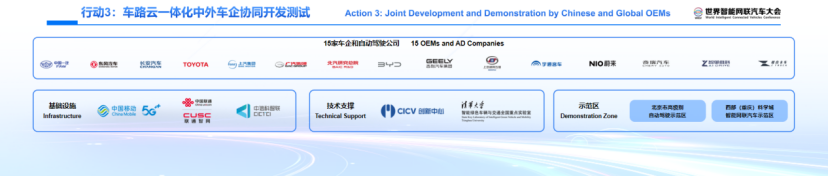
Action 1: Establish the Alliance of Pilot City Platforms for Vehicle-Road-Cloud Integration. Organized by CAICV and jointly initiated by the platform companies of the pilot cities, the alliance will focus on enforcing unified architectural standards, harmonizing infrastructure hierarchies, developing cloud control platforms, building and operating application scenarios, supporting automakers in application development, and promoting mutual recognition of road testing results.
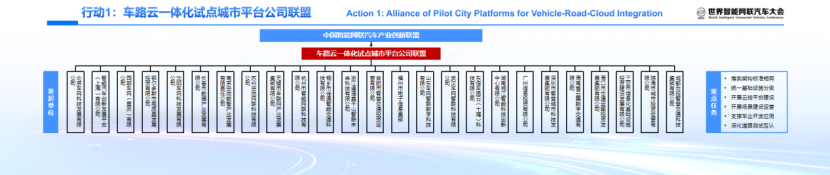
Action 2: Vehicle-road-cloud integration cross-region cooperation. Pioneering cross-region cooperation is underway in city clusters such as the Beijing-Tianjin-Hebei region, the Ningbo-Wuxi-Suzhou region, the Hangzhou-Tongxiang-Deqing consortium, and the Haikou-Sanya-Qionghai consortium, focusing on platform interconnection, road interoperability, and cross-region scenario deployment.
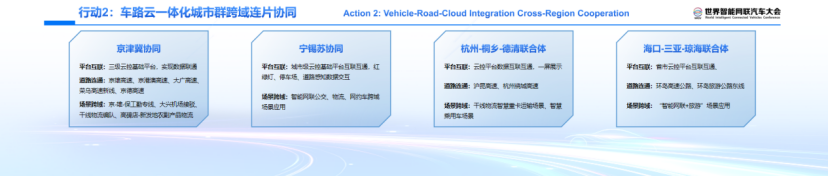
Action 3: Joint development and demonstration by Chinese and global OEMs. CICV and Tsinghua University are jointly organizing 15 Chinese and international automakers and autonomous driving companies—including FAW Group, Dongfeng Motor, Changan Automobile, Toyota, BYD, and Geely—with support from China Mobile, China Unicom, and CICT Connected and Intelligent Technologies Co., Ltd. (CICTCI). Collaborative development and testing are being carried out in the pilot cities of Beijing and Chongqing to align technological pathways and accelerate the large-scale adoption of the vehicle-road-cloud integration feature in vehicles.
The released phased achievements of the “vehicle-road-cloud integration” pilot program provide a comprehensive summary of the ICV industry’s progress since the introduction of the pilot policy, further strengthening confidence in the sector’s development. Going forward, China will remain committed to advancing the “vehicle-road-cloud integration” technological pathway, building industry consensus, and jointly promoting the industrialization and large-scale deployment of the integrated system.
Previous article
Next article